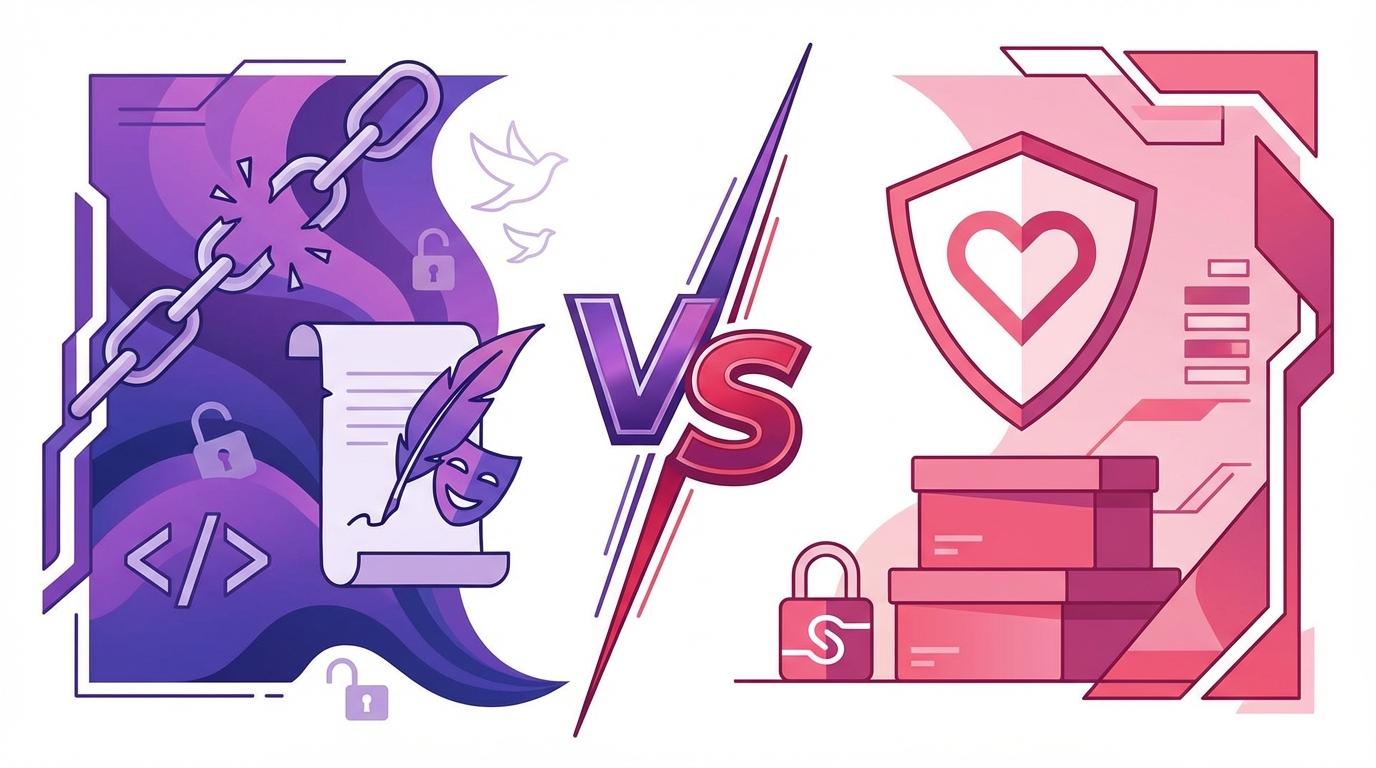
Shakespeare vs. Lovable
Comparing open source Shakespeare to Lovable. We break down code ownership, pricing, AI choice, deployment options, privacy, and why open source keeps you free.
You want to chat with an AI and have it build you a website or app and you're wondering whether to choose a mainstream platform like Lovable, or go with open source Shakespeare by Soapbox. While we're a small name, we think we offer a comparable or even better experience. Shakespeare will benefit you whether you have no coding ability and even if you're a full-stack dev. It meets you at your level of skill, or lack of it.
We'll focus on Lovable, a well-known name in generative web app builders that markets itself as beginner-friendly and fast. While Lovable excels at ease of use, it has significant drawbacks around pricing, data rights, and portability. We'll compare how it stacks up based on what matters most: ownership, privacy, and freedom.
Do You Own Your Code With Lovable?
In short, yes--but with major caveats. While you technically own your code, Lovable's Terms of Service grant the company a "worldwide, perpetual, royalty-free license" to use your Customer Data (excluding personally identifiable information) for their business purposes. This includes developing and training AI models, creating benchmarks and analytics, and "any other lawful business purpose."
If you want to opt out of having your code used to train their models, you'll need to either contact Lovable Support (for Free/Pro plans) or upgrade to a Business plan where admins can control this setting directly. While this is all subject to change as GenAI platforms give and take features away at will, this was such an issue that one Reddit user built a Chrome extension for it.
What's different with Shakespeare is the code is stored in your browser. That gives us no control over it. This also means there's some personal responsibility required. If you clear your browser cache without backing up your work, it's gone. This is why you should back up with GitHub or GitLab when using Shakespeare.
If you're non-technical, and the concept of Git is too much, Shakespeare lets you quickly download a zip file of your project as backup for free. If you ever lose your work, you can upload it to Shakespeare and tell it, "Build this." You'll quickly get your project back in this way.
GitLab: An Alternative to GitHub
As an added bonus, we allow you to use GitLab rather than give you GitHub as your only option. Most builders give you GitHub for syncing your projects; very few give you GitLab as an option. While GitHub has long been the industry standard for version control and collaboration, some have expressed concerns about Microsoft's acquisition of it and how the GitHub CEO stepped down as the organization became more folded into Big Tech. If you share this concern, GitLab would be a great choice for you.
Open Source Keeps You Free
Lovable is a closed-source, proprietary platform. While it won't ban you the way some platforms might, you're still at the mercy of their terms, pricing changes, and data policies. That's something Shakespeare won't do and none of our tools at Soapbox will do that to you.
With Lovable, your projects live on their servers. They can see everything you build, every chat you have with the AI, and they explicitly reserve the right to use that data. For activists, journalists, or anyone working on sensitive projects, this should be a dealbreaker.
Lovable vs. Shakespeare: Pricing
Lovable requires you to choose a monthly recurring subscription. You can experiment for free, but to deploy anything meaningful, you must pay. Shakespeare works on a pay-per-use basis with AI credits. You can also Bring Your Own Key (BYOK) via OpenRouter or another AI provider to both platforms--though Lovable makes this difficult for non-technical users.
Going with pay-per-use AI credits in Shakespeare may serve you better than having all your subscription credits eaten up by doom loops and debugging--a frequent complaint about closed-source platforms. Having this problem also depends on how you use the tool.
Shakespeare is more incentivized to take you off of this path so that you get more out of your AI credits. We want to teach you how to debug, not charge you for endless, unproductive loops. Our goal is to increase your AI literacy, help you understand how Shakespeare works, and give you basic knowledge as well as tech guardrails so you get the most out of it. We want working with AI to be fun, fast, and inexpensive.
Lovable vs. Shakespeare: Payment Options
Lovable
- Card payments
- Subscription tiers
- No Bitcoin payments
Shakespeare
- Card payments
- Pay-per-use credits
- Bitcoin payments
With Lovable, you must pay with a credit card and commit to a subscription tier. There's no option to pay only for what you use. With Shakespeare, you have the option to pay with a card or choose to pay in Bitcoin. Lovable doesn't offer Bitcoin payments. This makes Shakespeare accessible to the unbanked and those who value financial privacy where Lovable is not.
Lovable vs. Shakespeare: AI Choice
Lovable chooses your AI model for you. While technically you can use OpenRouter to access different models, this requires developer knowledge--not exactly beginner-friendly. Shakespeare lets you choose your AI model from the start and change it at any time based on the task at hand. Want to use Claude for planning and GPT-5 for implementation? Shakespeare makes that easy. You can switch between models based on their strengths--something Lovable doesn't offer.
Lovable vs. Shakespeare: Local LLM Support
Lovable offers essentially no support for local models. If you want to run AI privately on your own machine, Lovable isn't designed for that. Shakespeare works with local models like Ollama, GPT-OSS, DeepSeek R1, and Gemma 3. Working with a local LLM is the most private way to work with an AI provider. Here's a guide we wrote to help you get started with local AI in Shakespeare.
Lovable vs. Shakespeare: Import and Export Existing Projects
This is where Lovable really stumbles. You can export your code to GitHub, but you cannot import code from GitHub back into Lovable without a workaround that requires developer-level skills. You're essentially on a one-way street. Shakespeare syncs to GitHub, GitLab, and will let you import any existing zip files. We believe in bidirectional workflows. Your code should move freely in and out of any platform.
Lovable vs. Shakespeare: Git Integration
Lovable syncs to GitHub, but only one way--you can push to GitHub but can't pull from it. Shakespeare syncs to both GitHub and GitLab bidirectionally. You can also add a custom Git provider and Git identity. We give you options when it comes to version control.
Lovable vs. Shakespeare: Deployment Options
Lovable has limited deployment options and they're tightly integrated with their platform. You'll need a subscription to deploy anything meaningful.
Shakespeare Deployment Options
You have the freedom to deploy wherever makes sense for your project.
Lovable vs. Shakespeare: Nostr Support
Lovable technically can work with Nostr, but barely. When tested, Lovable's understanding of Nostr was extremely limited and it incorrectly categorized it as "Web3." If you want to build websites and apps on Nostr--a truly open, censorship-resistant protocol--Lovable is not the tool for you.
Shakespeare has native Nostr support. This means Shakespeare just "gets" things like Nostr login, NIPs, kinds, and every other detail of building on this open source protocol. If you want to build websites and apps that are uncensorable and open, Shakespeare is purpose-built for that.
Lovable vs. Shakespeare: Project Privacy
This is perhaps the biggest difference between the two platforms. Lovable can see everything: your code, your conversations with the AI, your project data. Their Terms of Service explicitly state they can use your Customer Data for model training, analytics, and other business purposes unless you opt out or upgrade to a Business plan.
Lovable's data retention policy states they "may retain indefinitely Customer Data in an anonymized and aggregated form." Even after you delete your account, they may keep your data for "fraud prevention, legal defense, or to comply with legal obligations." Your deleted data "may persist in backups for a limited time before being permanently removed."
With Shakespeare, your code is stored in your browser. We literally cannot see what you're building. We can't use your code to train models because we don't have access to it. For journalists, activists, dissidents, or anyone who values privacy, this distinction is critical.
Lovable's $50/Month Paywall to Export a Zip File: A Red Flag
Vendor Lock-In Warning
Even more concerning: if you want to export your project as a zip file, you'll need to upgrade to Lovable's Business plan at $50/month. This means a feature as basic as downloading your own code requires an ongoing subscription.
This is vendor lock-in disguised as a feature tier--it creates an ongoing financial barrier to leaving their platform and taking your work with you.
Shakespeare lets you download your project as a zip file anytime, for free. Because we believe you should own your work without paying ransom for it.
This policy takes advantage of the general public's lack of skill when it comes to software development.
Shakespeare: Free Zip Downloads
With Shakespeare, you can download a zip file of your project anytime, completely free. No subscription required. No barriers to taking your work with you. Your code belongs to you.
Ready to try Shakespeare?
Experience open source AI-powered development. No subscriptions. No data harvesting. Your code, your freedom.
Related Reading
Soapbox is funded by grants and donations, not ads or data sales.
Everything we build is open source and belongs to the community. Help us keep it that way.