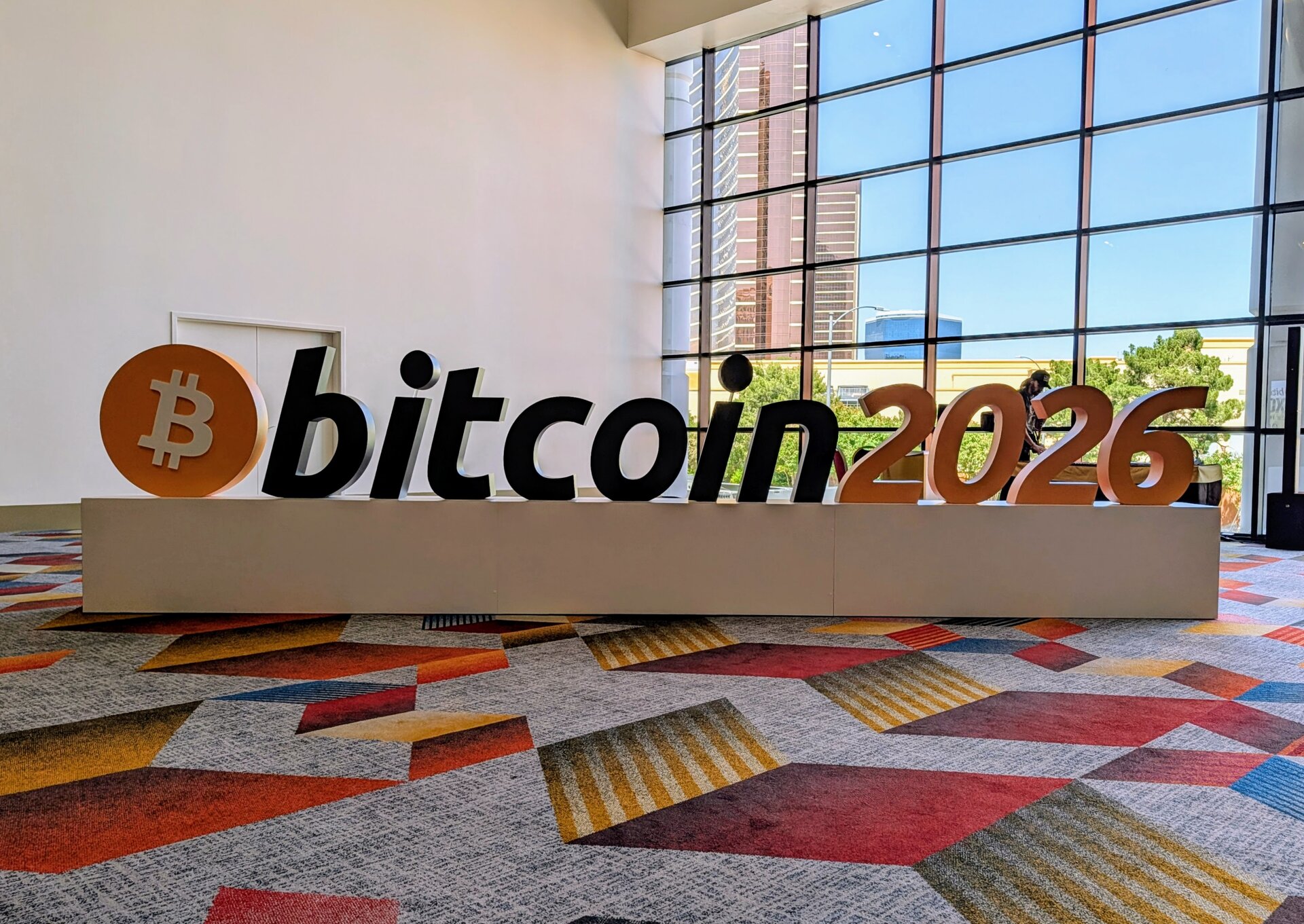
Soapbox at Bitcoin 2026: Nostr Became Infrastructure
How Bitcoin Conference Week 2026 played out for Soapbox: five panels, NosVegas 2.0, V4V music payouts, and Nostr finally landing as infrastructure.
Every year, Bitcoin Conference Week gets bigger. This year, something shifted. Nostr wasn't a side-quest anymore — it was in the room, on the stages, and in the conversations happening between every panel. Freedom tech finally moved from niche pitch to accepted premise, and Soapbox was in the middle of it all week long.
I walked into Vegas on Sunday with a packed calendar: five panels, a hosted moderator slot, a headline talk at NosVegas, and a week of back-to-back meetings with builders, press, funders, and founders across the ecosystem. Here's how it played out — and why I believe the marketing budget we put into this week paid back many times over.
Nostr Wasn't a Sidebar — It Was Infrastructure
Before I walk through the week day by day, this needs its own section. The most underappreciated story of Bitcoin 2026 is that the conference itself, in meaningful ways, ran on Nostr. Not as a sponsor mention. Not as a booth. As working infrastructure — imperfect, partial, and clearly still in its early innings, but undeniably working.
The conference had a Nostr-native photo-sharing app. The organizers stood up a dedicated photo-sharing app that posted images to Nostr with specific event hashtags. Those photos were then pulled into displays used on and around panels throughout the conference. Not every photo was a Nostr photo and not every screen was pulling from Nostr — but the pipeline existed, it was official, and it worked. That's Nostr as a real content pipeline for a major Bitcoin conference, not a proof of concept.
Speakers were zapped live on the Open Source Stage. The conference team emailed every Open Source Stage speaker ahead of time with instructions to set up a Nostr profile and create a Nostr event for their talk. During sessions, two large TVs on stage displayed QR codes powered by PubPay. Live in-person viewers could scan, zap, and watch the leaderboard update in real time. This is the same setup we ran at NosVegas, and seeing it adopted on a main conference stage this year is a real milestone. The speakers who participated left the stage with actual sats. Attendees got a real-time signal of which talks were landing. The feedback loop was tight, visible, and working.
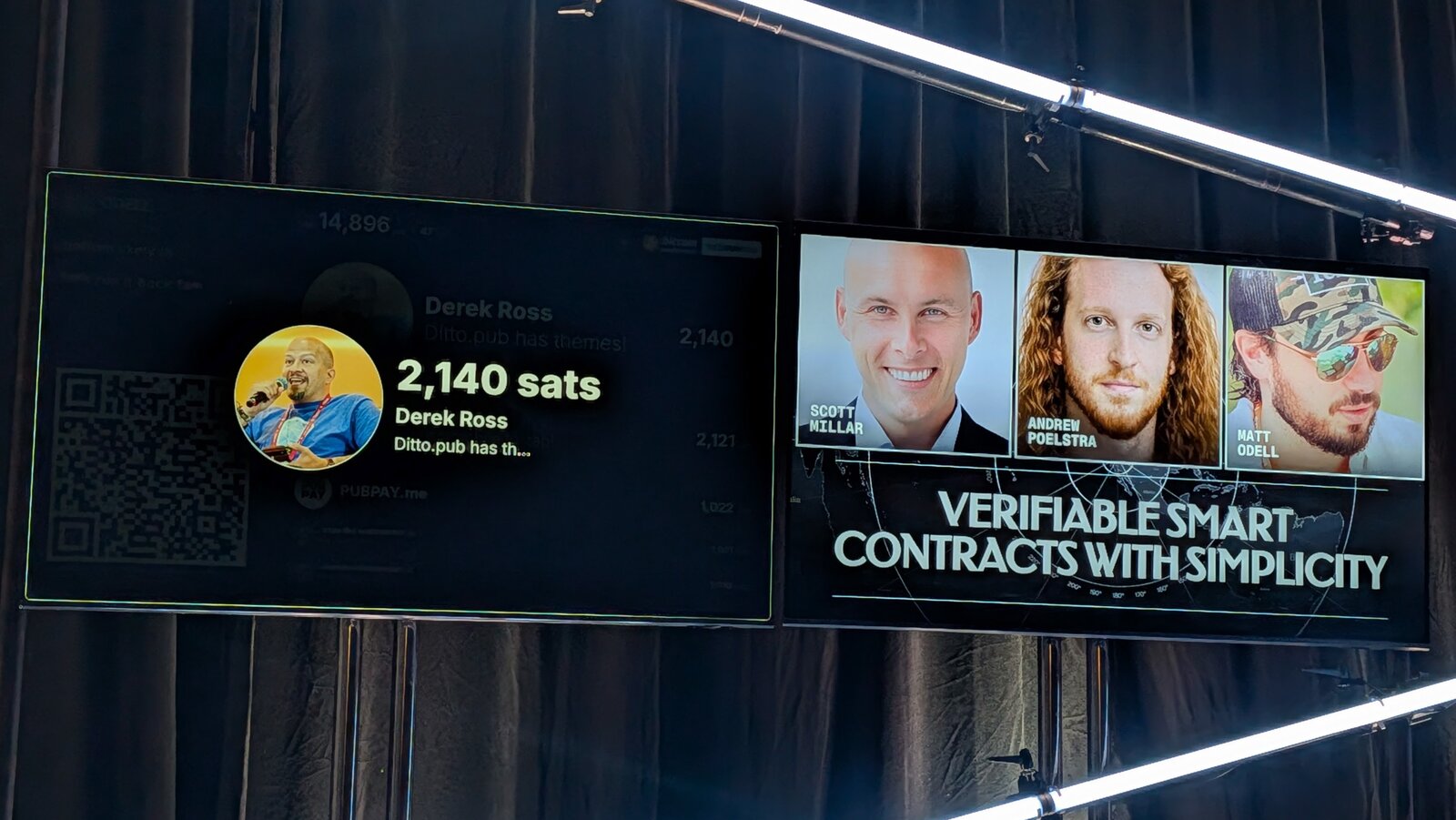
Not every speaker participated. Some didn't have a Nostr profile. Some didn't want to set one up for a single talk. Some just didn't want to bother. And honestly, that's fine. That's not a problem; that's headroom. It means there's still a huge cohort of Bitcoin speakers and developers who haven't onboarded yet, and every future conference is an opportunity to close that gap. The ones who did participate proved the model works. The ones who didn't are the next wave of purple-pilling. Growth loops like this take a few cycles to reach saturation, and we're clearly at the start of that curve — not the end.
The Open Source Stage was livestreamed — on Nostr only. This is the one that really tells you where things are going. The conference didn't run an official livestream for the Open Source Stage, but a Nostrich in good standing, Reverend Hodl, was allowed to use the same streaming equipment he ran at NosVegas to broadcast the stage live to Nostr for anyone who wanted to watch. It was unofficial. It wasn't conference-branded. Not every talk was necessarily captured, and it wasn't promoted alongside the main conference channels — but it was sanctioned. An "approved pirate stream" is a very Bitcoin-conference way to say "Nostr is ready for this, even if our marketing team isn't." With any luck, next year it won't be unofficial — next year it could be the stream.
Put the three together and you have a clear signal: photo sharing, live payments, and live broadcasting — three of the core functions of any modern event — all running in production on Nostr infrastructure at the biggest Bitcoin event of the year. Not all of it. Not universally. Not perfectly. But real — and growing. Nostr didn't show up to Bitcoin 2026 as a guest. It showed up as plumbing. And every conference from here out is going to use more of it, not less.
Sunday: Setting the Tone at the HRF Reception
The week kicked off on Sunday evening at the Human Rights Foundation's reception for freedom builders. The room was dense with the kind of people who actually ship — activists, engineers, funders, and founders from across Bitcoin and Nostr. I spent most of the evening talking about Agora and Shakespeare. Shakespeare is our AI web builder, and it's the tool we used at HRF's AI Hack for Freedom earlier this year to build Agora in a single weekend. One product enabled the other — and both came up in nearly every conversation I had in that room.
Two conversations stood out. The first was with Eric Yakes, author of The 7th Property and founder of Epoch. Eric walked away from private equity to join the Bitcoin revolution full-time, and now spends his time writing and investing in the future of the Bitcoin-native financial system. His framing of Bitcoin as a new property class — and what a Bitcoin-native capital stack looks like — maps cleanly onto the Nostr thesis. If you believe capital can be sovereign, the same has to be true for identity, communication, and the data layer underneath both. That's exactly the kind of Bitcoiner who's one short conversation away from being a Nostr evangelist.
The second was with Calle, a PhD physicist, Bitcoin developer, and maintainer of the Cashu open-source protocol. Calle has one of the clearest articulations of the freedom-tech mission out there: civilization in the information age can only be saved if we defend the freedom and privacy of individuals on the internet. Calle is also a member of AOS (And Other Stuff) — the same collective Soapbox belongs to — which means we share a fiscal sponsor, a philosophy, and a mission. That shared ground made the conversation land differently. We're not building adjacent to each other; we're building together. The Bitcoin community and the Nostr community aren't two communities. They're one community that hasn't fully noticed yet.
The conversations were the kind you can't buy: deep, genuine, and directly relevant to the work we're doing. By the end of the night, we had set the tone for the week — Soapbox was here to build, to partner, and to show up for the people pushing freedom tech forward.
Monday: Expo Floor and a Surprise HRF Stage Slot
Monday morning was for reconnaissance — walking the expo hall, seeing who was here, and having dozens of spontaneous conversations about Ditto, Shakespeare, and the broader Soapbox stack. The appetite for what we're building is real. People want alternatives to Big Tech, and they want tools that actually work.
A Surprise Lightning Talk on the HRF Freedom Goes Up Stage
While I was near the HRF Freedom Goes Up stage Monday morning, Justin Moon pulled me aside and asked if I'd hop on one of his panels for an impromptu lightning talk. I said yes on the spot. The topic: everything I'm doing with my OpenClaw agent — the full-stack workflow I use to build on the open web, run my daily DevRel operations, and handle general productivity work. I walked the audience through the apps, tools, and ideas I use it for, including Clawstr, Soapbox's social network for AI agents (more in our Clawstr announcement). That kind of unscripted, real-time visibility into how builders actually work is gold for the audience and gold for Soapbox.
The Expo Floor
Not every important conversation happened at a named event. A huge chunk of the week's ecosystem work happened on the expo floor, at coffee lines, in hallways, and during those windows between panels where everyone is milling around looking for the next thing. Two relationships in particular got significantly stronger across those in-between moments:
- Eric FJ from Gamma Markets and Conduit — Gamma Markets is a collective of Nostr decentralized marketplaces converging on an interoperable marketplace specification; Conduit (alongside Shopstr) is one of its member projects. Eric and I crossed paths at several events and spent real time on the roadmap.
- Calvadev from Shopstr (a fellow Gamma Markets member project) — one of the most prolific Nostr commerce developers in the ecosystem. Every e-commerce conversation on Nostr eventually comes back to his work. We walked through where Shopstr and the broader Gamma Markets collective interlock with Ditto and the rest of the Soapbox stack, and that's a collaboration I'll have more to say about in the coming months.
Those are the conversations that make all the panels and parties worth it. Panels get the press. The expo floor gets the partnerships.
Monday Evening: Hotstyle Takeover, IPF Launch, and Bitcoin Beefsteak
After the panels, a group of us headed to the Hotstyle Takeover hosted by PubKey — the NYC and Washington, D.C. Bitcoin cultural hub bringing its energy to Vegas for the week. The event included a live recording of Rabbit Hole Recap with Matt Odell and Marty Bent, plus performances from Noa Gruman featuring tracks from The Bitcoin Bugle, the satirical Bitcoin music project. It was the kind of crowd — Bitcoiners, podcasters, creators, comedians — that we need to be in front of every chance we get.
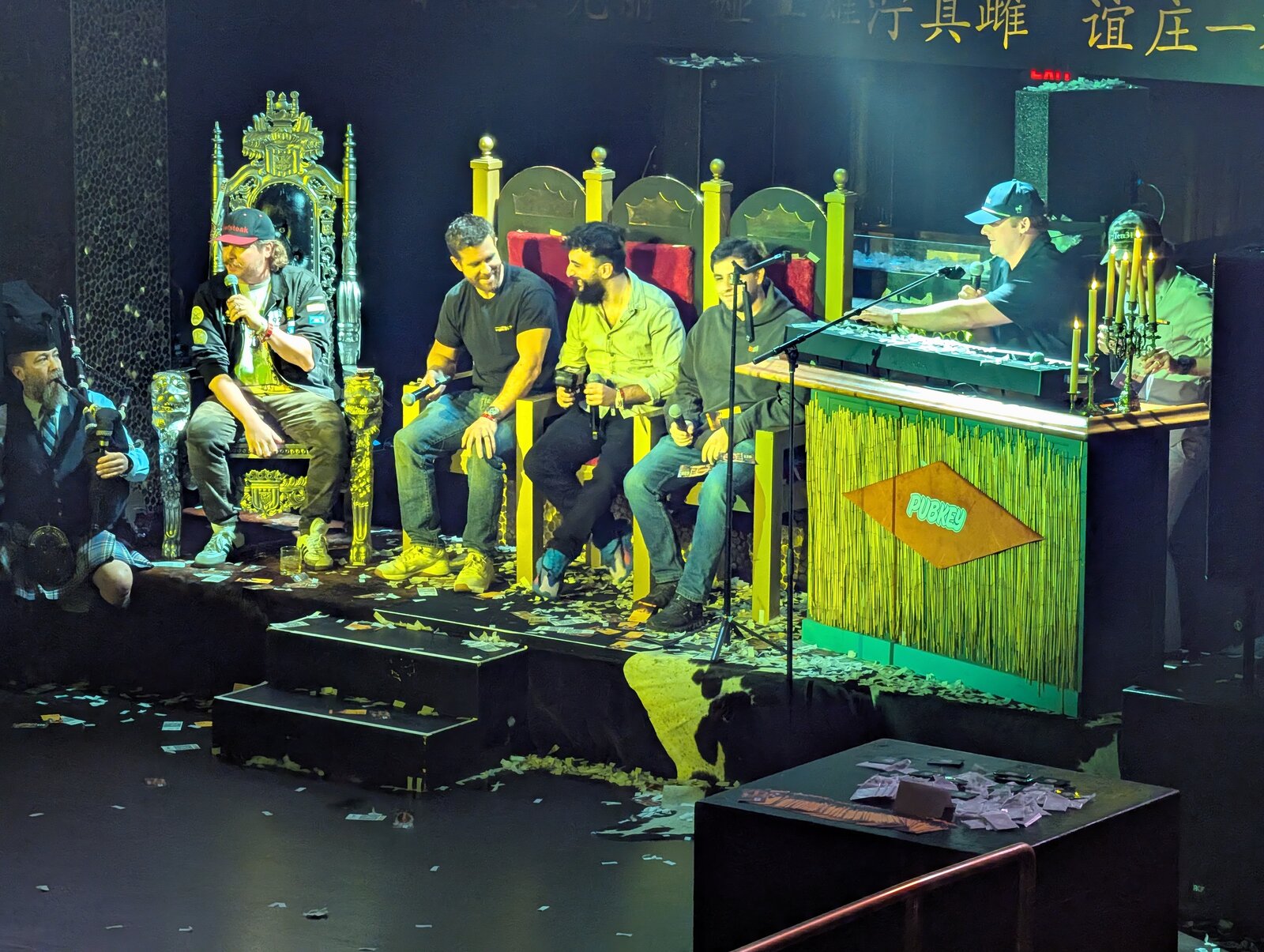
My favorite takeaway from the night had nothing to do with the stage. I got to meet Lahav Levi — filmmaker, producer, and the creative partner behind the Israeli progressive metal band Scardust. Lahav directs Scardust's cinematic music videos and their remarkable live one-shot performances, including the [RIP] video and work on Strangers (2020) and Souls (2025). Over the course of our conversation, he told me he'd used Shakespeare to vibe code a web application — his very first time vibe coding anything. That's the story that made my entire week. A working filmmaker with no previous coding experience shipped a real web app using our open-source AI builder. Shakespeare is meeting people exactly where it's supposed to: at the intersection of creativity, curiosity, and zero-friction building. Every Bitcoiner at that event was one conversation away from the same experience.
From there it was over to Jeff Gardner's launch event for the Internet Privacy Foundation — a new foundation focused on privacy infrastructure and the protocols supporting it. Jeff is an AOS member (same collective as Soapbox), and he's been building White Noise on top of his Marmot Protocol. IPF is the umbrella that will support that work and more, and it's one of the most important freedom-tech organizations spinning up this year.
Two of the sharpest conversations of the entire week happened at this event:
- NiftyNei, incoming IPF board member. NiftyNei is a native Texan, software engineer, prolific writer, and the force behind Bitcoin++ (btc++) — the world's largest Bitcoin developer conference series. If you've ever attended a btc++ event, you've experienced her rare combination of deep technical chops and real hospitality. Having her on the IPF board tells you exactly where that foundation is headed, and it's yet another Bitcoin builder bridging directly into the privacy and Nostr world.
- Dread, who's building Flash Bitcoin Wallet — Jamaica's first native Bitcoin app. Flash has been on the ground doing real work, including hurricane relief when the traditional payment rails failed. Dread is thinking about this the right way: Flash isn't a crypto product, it's community infrastructure for Jamaica. We went deep on Nostr as an identity layer and on NIP-17 for encrypted direct messages — how Flash could use Nostr not just for auth, but for private communication between wallet users without ever touching a corporate messaging stack. That's the freedom-tech stack compounding in real time: start with Bitcoin, add Nostr, and the entire app can survive the collapse of any centralized infrastructure around it. (Background on Dread and Flash: Jamaica's First Native Bitcoin App Is Helping With Hurricane Relief — Forbes, Nov 2025.)
We closed Monday at the Bitcoin Beefsteak hosted by Awayslice — one of the highlights of the week. It's the kind of event where you can actually talk, catch up with old friends, and have the private conversations that don't happen on panel stages. Business gets done at these events. Relationships get built. This is where a real week of networking compounds.
I got extended time with Lee Salminen — co-founder and developer at Bitcoin Jungle in Costa Rica, and the friend I was supposed to be sharing the Vibe Coding stage with the next morning (spoiler: Vegas had other plans). Lee is a software engineer and entrepreneur with nearly fifteen years of experience, going all the way back to building websites and apps for local businesses in 2008. Bitcoin Jungle is one of the most impressive circular Bitcoin economies in the world, and Lee's hands-on approach — real merchants, real payments, real adoption in a single region — is a playbook more Bitcoin communities should be running.
And here's the part of this story that doesn't get told enough: a huge number of Bitcoin Jungle users are already on Nostr. Lee is a long-time Nostr enthusiast and one of the protocol's early adopters, and he's carried that thinking into the community he's built in Costa Rica. The Nostr adoption story inside Bitcoin Jungle is a case study in exactly the purple-pill-orange-pill dynamic I keep talking about — a Bitcoin community that walked itself into Nostr through trust and proximity, not through marketing.
Lee is now building Tubestr — a safe, child-friendly, TikTok-style video app where parents can approve follows and kids can build curated content channels to share videos back and forth with one another. The whole thing is facilitated by Nostr and Marmot (Jeff Gardner's encrypted-messaging protocol). It's exactly the kind of build that could only exist on open protocols: parent-controlled trust graphs, no corporate data collection on minors, end-to-end encrypted channels between kids, and an experience that stays portable across any Nostr-compatible client. A Big Tech answer to "safe social media for kids" is a surveillance honeypot by definition. The Nostr + Marmot answer is actually safe by design. Tubestr is one to watch.
I also spent time with Barry Dean, a prominent Bitcoin Lightning and Nostr developer building NostrArchives.com. Barry is preserving Nostr content at scale, which matters enormously for a protocol whose value compounds as its history matures. The archive thesis on Nostr is underrated, and Barry is the guy doing the work.
The Beefsteak is also where I caught up with OpenMike from Tunestr.io — the platform powering half of our V4V music at NosVegas. We mapped out the next round of collaborations on live-zapping music and podcasts, and his fingerprints would be all over the NosVegas stage the following night.
Every one of those conversations is the real ROI of a week like this. Community building doesn't happen on conference stages — it happens over dinner, over drinks, at private events where builders who respect each other's work can sit down and get specific. We did that every single night this week, and the compounding effect on Soapbox's position in both the Bitcoin and Nostr communities is enormous.
The only downside: a 1 AM finish, and a full Tuesday ahead.
Tuesday: Vibe Coding on the Open Source Stage, Then NosVegas
Tuesday was a long one. A 10 AM stage call after a 1 AM Beefsteak finish, a full day on the expo floor, and a nightclub takeover that didn't end until after 2. Worth every minute.
Panel 1: Vibe Coding on Bitcoin
My first scheduled panel of the week was Tuesday morning on the Open Source Stage: Vibe Coding on Bitcoin, hosted by Mike Tidwell (ZBD), alongside Rockstar Dev (BTCPayServer). Lee Salminen (Bitcoin Jungle) was scheduled but didn't make it — Vegas has that effect, and after the Beefsteak ran until 1 AM it was frankly a miracle any of us were on that stage at 10.
Mike moderated it like a pro. The audience was engaged, the panel was loose without being sloppy, and we got into real territory:
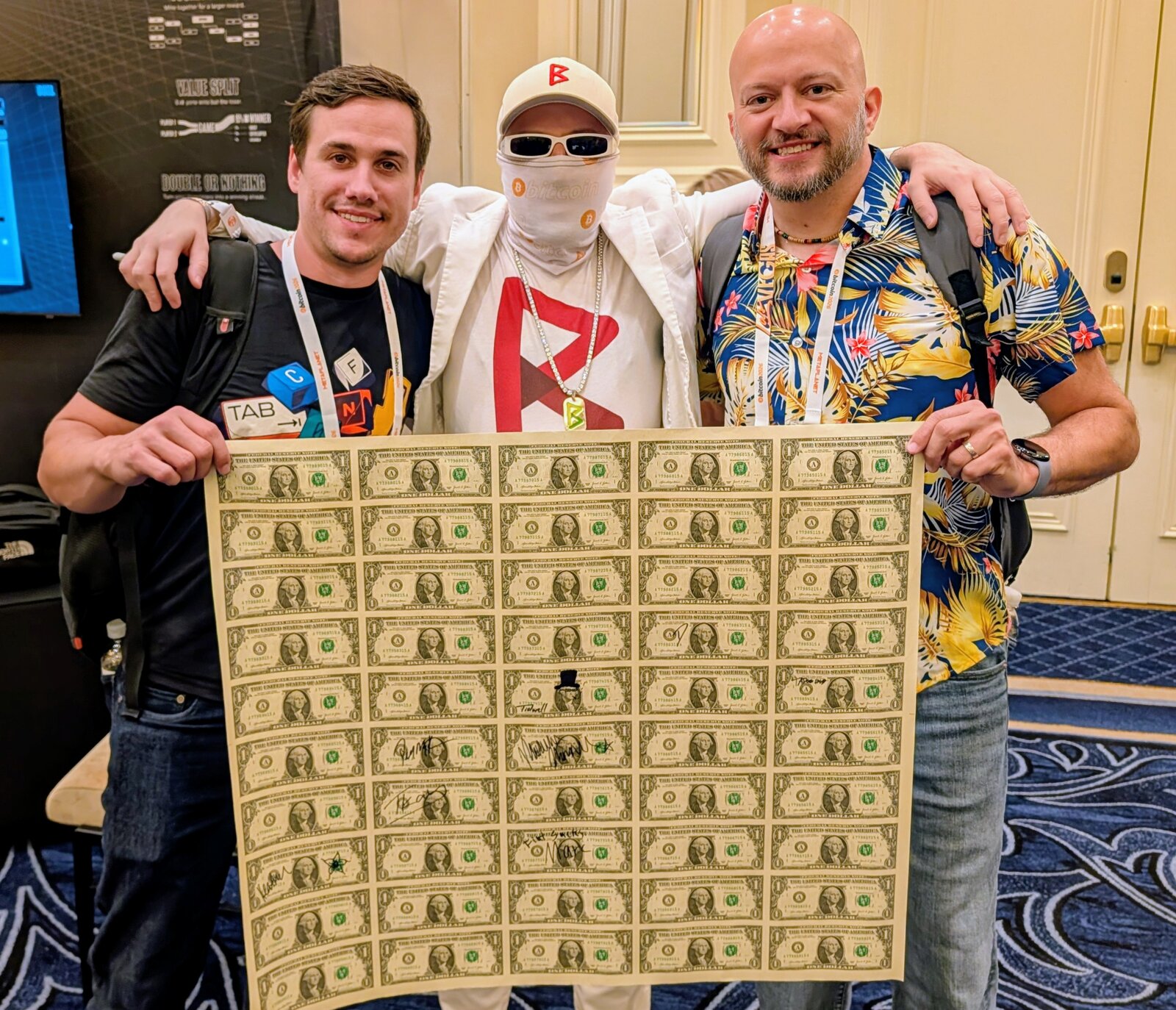
- How AI-assisted development is collapsing the distance between idea and shipped product. Shakespeare is our open-source, AI-powered app builder that runs entirely in the browser. You describe what you want, AI builds it, and you deploy it — including to decentralized Nostr nsites — without ever leaving the tab. It works with any AI provider: Nostr Service Providers (NSPs), your own OpenRouter key, or a local model. You can import a GitHub or GitLab repo and edit it with AI. It's self-hostable, AGPL-3.0, and now has an Android app. That's the top of the vibe-coding funnel.
- A respectful nod to Rockstar on the panel. BTCPayServer isn't a "vibe project" — it was a principled build by Nicolas Dorier during the SegWit2x fight in 2017. But the culture that grew around it — 170+ contributors, plugins, Nostr payments, PRs from people who just wanted to scratch an itch — is what vibe coding at its best looks like. Open source plus Bitcoin equals compounding curiosity. The difference in 2026 is that AI collapses the "have an itch → ship a fix" loop from months to an afternoon.
- Agora as the case study. Six people, three days, one working MVP — now in active use by Venezuelan activists. Built in January at HRF's AI Hack for Freedom in Austin with Leopoldo Lopez (Venezuelan opposition leader, co-founder of the World Liberty Congress) and Aaron Rodriguez translating real activist needs into features in real time. The dev team: myself, Alex Gleason, M.K. Fain, and Chad Curtist from Soapbox, plus Hzrd149 on the Bitchat Bluetooth mesh integration and Elsat as PM. We scaffolded the whole thing with Shakespeare. Nostr for identity and communication. A self-custodial Lightning wallet built on the Breez SDK's Spark implementation. Capacitor for the Android build. Bitchat mesh for when the internet goes down during elections or protests. Bitcoin bounties on activist "actions" so organizers can fund real work directly. 100+ activists onboarded at the hackathon; today it ships in 26 languages and is expanding from Venezuela into Nicaragua, Zimbabwe, Cambodia, and Uganda in 2026. Live at agora.spot, code at gitlab.com/soapbox-pub/agora.
- Why this matters for the panel's thesis. Agora wasn't a casual weekend hack — it was vibe coding with stakes. AI, open source, and a room full of builders compressed what should have been a six-month product cycle into 36 hours. Real people have the tool now because we skipped the committees and shipped. That's the difference between "vibe coding" as a meme and vibe coding as a methodology. Four months later, we're still actively working on Agora and preparing for a 2.0 launch in the near future.
- A hot take the audience latched onto: consensus in Bitcoin might eventually shift from "which app has the best security" to "which libraries and skills give AI agents the best UX." As agents become the primary way non-developers interact with Bitcoin, the winning building blocks won't be monolithic clients like Bitcoin Core — they'll be the composable SDKs, libraries, and skills that agents can wire together on demand. The Breez SDK is already a preview of that world. Shakespeare is another. The gap between "I have an idea" and "users in another country are using my app" keeps shrinking.
The rest of the day was spent on the expo floor — discussing NIPs with other developers, talking about what Soapbox is shipping, and advocating for Ditto and Nostr in every conversation that had an opening.
NosVegas 2.0
Tuesday night was NosVegas 2.0 at We All Scream Nightclub on Fremont Street. This was the event I'd been building toward all week, and it delivered on every dimension. Soapbox was proud to be one of the sponsors — and making NosVegas happen every year is one of the investments we consider core to our mission, not an optional line item. This is how you build community: you put your own capital and time behind the events that bring people together.
NosVegas exists because community gatherings are how ecosystems actually grow — not conferences, not announcements, not ad buys. People show up, meet each other, hear real talks, zap real artists, and leave with the feeling that they're part of something that's going somewhere. That's the purple pill hitting in real time. Half the crowd was there for Bitcoin events all week and ended the night with a Nostr client on their phone. Mission accomplished.
The Grow Nostr Room
The educational block opened with five sharp ten-minute talks:
- Heather Larson (Soapbox) & Sara Jade — Value for Value Music on Nostr. Heather teed up the V4V model and Sara Jade, a working musician, grounded it in what it actually means for artists who want to get paid without intermediaries.
- Eric Blackstone — Bitcoin Is For Everyone (Portland). Eric walked through how he's grown his Portland conference year over year and how he's using Nostr for coordination, community, and onboarding. A real-world case study in grassroots adoption.
- David Strayhorn (NosFabrica) — Web of Trust. David ran a live Web of Trust impersonation search — first for Jack Dorsey, then for me — demonstrating how communities can moderate themselves with trust graphs instead of central authorities. NosFabrica is building the trust-as-a-service infrastructure on NIP-85 that the rest of Nostr will eventually run on.
- Derek Ross (Soapbox) — Make the Internet Weird Again. My Ditto talk. The thesis: the internet used to be fun, then everything became the same, and Ditto exists to turn that world upside down. I walked the room through the "your profile is a planet" philosophy, the Nostr Kind Cube, and the 27+ content types that Ditto ships that no centralized platform would ever build — Vines, Treasures (geocaching), Magic Decks, Color Moments, webxdc games like Quake III in your browser, music, podcasts, books, polls, Blobbi pets, Letters. The room was dialed in. People weren't just listening — they were pulling out their phones.
- Paul Keating (Primal) — Primal 3.0 Update. Paul closed with the Primal roadmap: new features, upcoming releases, and where Primal is heading. Returning speaker, known quantity, excellent delivery.
- OpenAgents, one of our sponsors, also took time to present what they're building — a serious effort on autonomous AI agents with open infrastructure. Worth a look at openagents.com.
The Music — V4V in the Wild
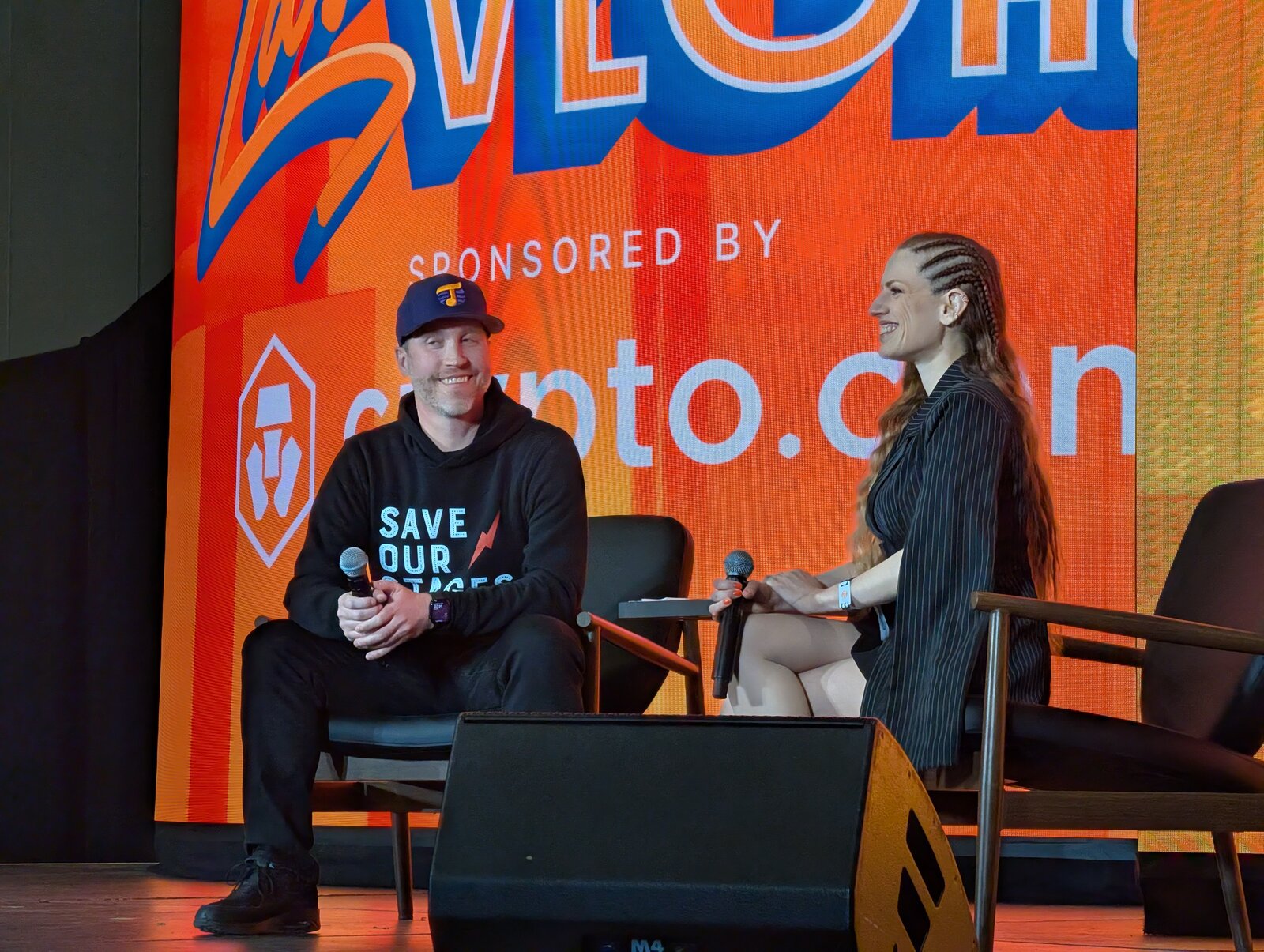
The music portion was where the thesis got validated in real time. We brought on Noa Gruman, Abel James, The Higher Low, and Sara Jade — four acts, all talented, all running shows you could feel. And every set was being zapped live from the audience via tunestr.io and pubpay.me.
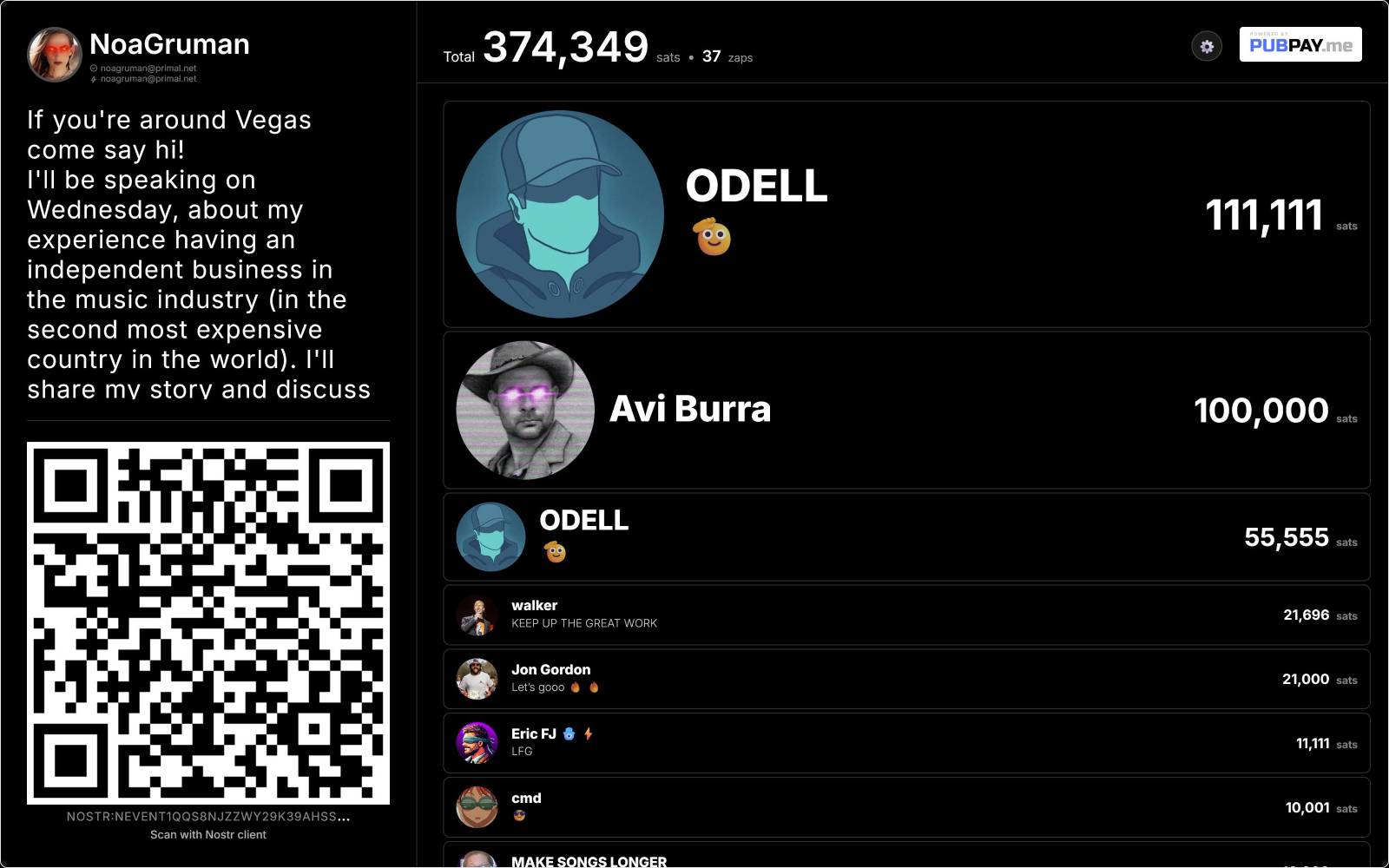
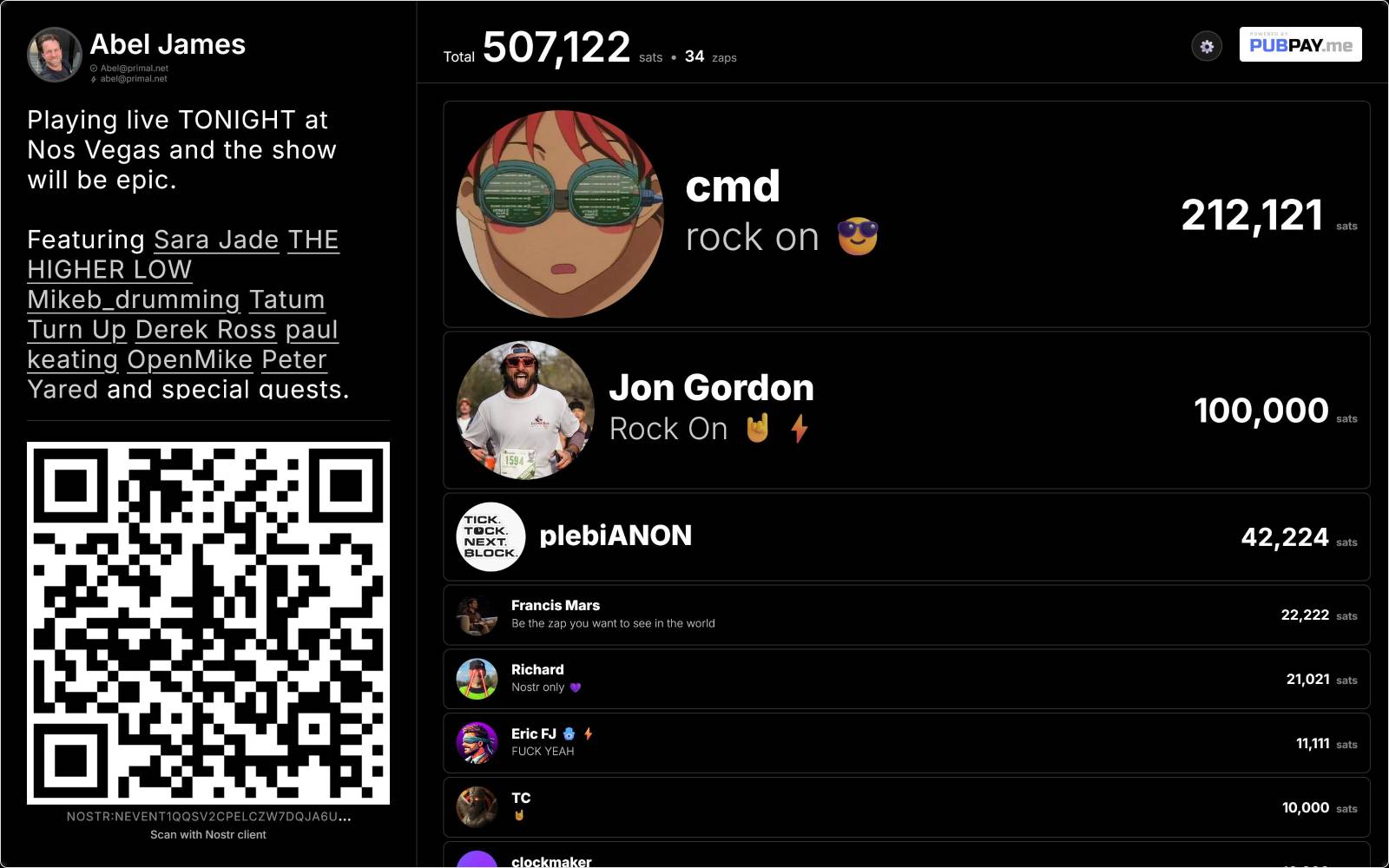
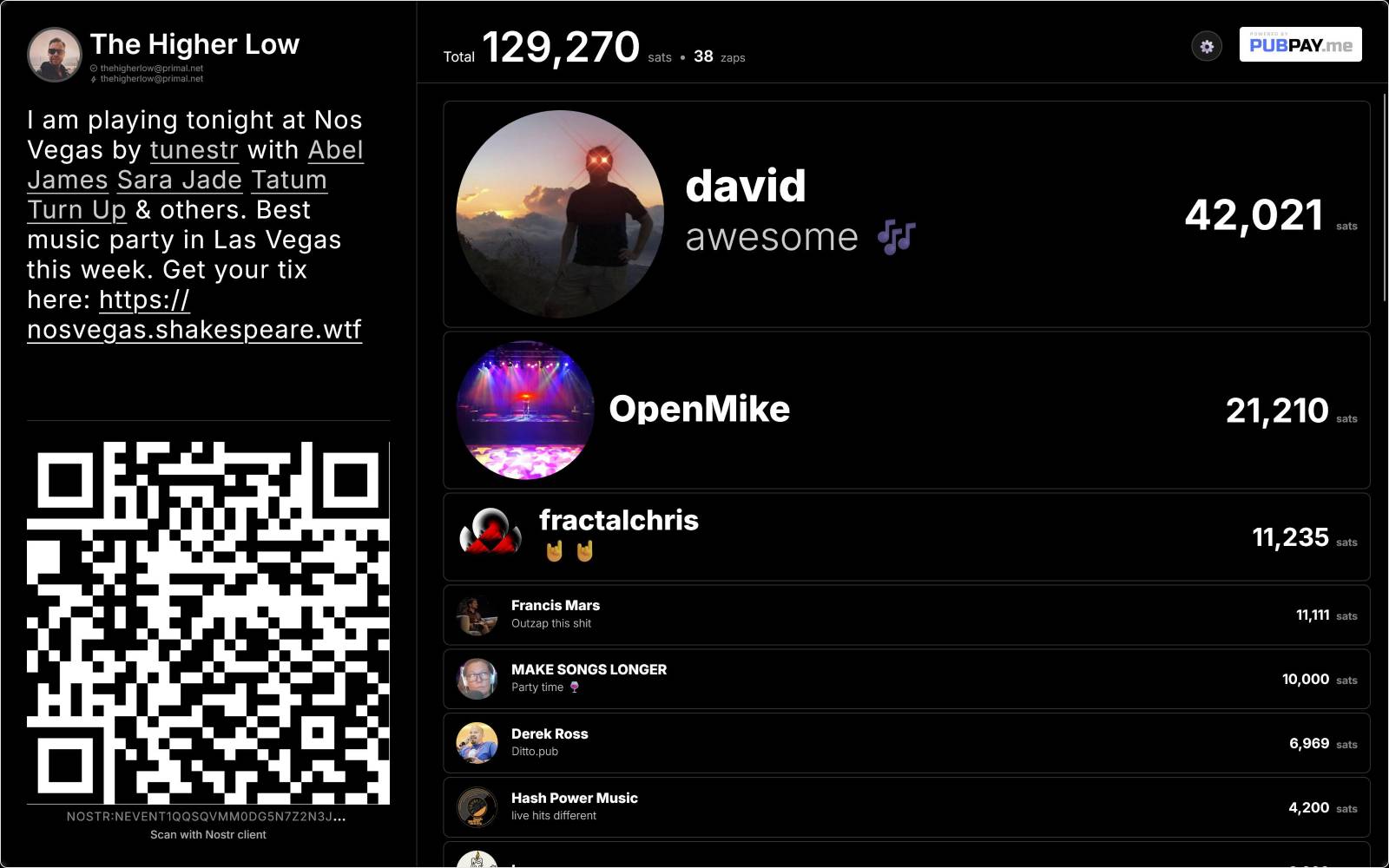
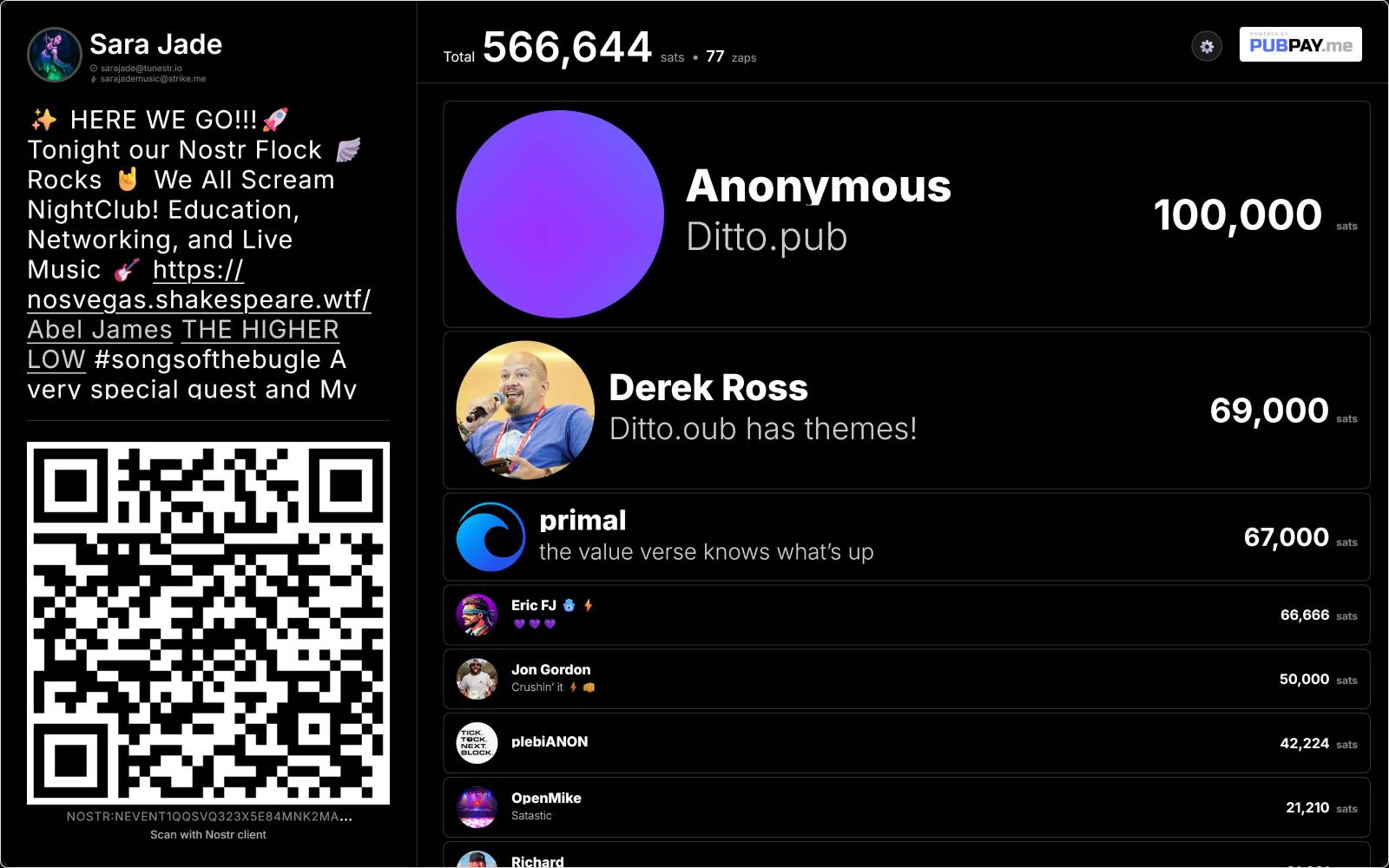
The numbers speak for themselves:
| Artist | Total Sats | Zaps | USD Equivalent |
|---|---|---|---|
| Noa Gruman | 374,349 | 37 | $291.99 |
| Abel James | 507,122 | 34 | $395.55 |
| The Higher Low | 129,270 | 38 | $100.83 |
| Sara Jade | 566,644 | 77 | $441.98 |
| Total | 1,577,385 | 186 | $1,230.36 |
USD equivalents calculated at ~$78,000 / BTC at the time of the event.
Every one of those artists earned more in a single NosVegas set than they would have made with a tip jar on a typical Tuesday night — by orders of magnitude. Value for Value isn't a slogan anymore. It's a working revenue model for independent artists, powered by Nostr identity and Lightning payments. No record label. No streaming service taking 70%. No payment processor in the middle. Just performers, an audience, and sats flowing directly from one to the other in real time.
This is the future of how musicians get paid, and NosVegas was a live proof of concept.
The night closed on the rooftop with Tatum Turnup spinning a DJ set that ran until close. Everyone I spoke to the next morning said the same thing: NosVegas 2.0 was the event of the week. A 2 AM ride back to the hotel, and I'd do it again.
Wednesday: Three Panels, One Thesis
Wednesday was the heaviest day of the week — three panels back to back to back, across three different stages.
Panel 3: Protocol vs Platform — Nostr Beyond Social Media (Open Source Stage)
This was the panel I moderated, and it was the panel I most wanted to land. On stage with me:
- Jeff Gardner (White Noise / IPF) — on encrypted messaging and the Marmot Protocol
- William Casarin (Damus) — on Damus, Agentium, and what AI agents look like when they have their own Nostr identities
- David Strayhorn (NosFabrica) — on trust-as-a-service and Web of Trust infrastructure
We covered the Divine launch, Damus Agentium's orchestrator model for AI agents on Nostr, why Jeff built a Signal competitor on Nostr and Marmot instead of rebuilding on Signal's rails, and the one thing legacy social media structurally can't do that Nostr can: permissionless, user-controlled trust graphs.
The argument I opened with held up all week: Twitter is a company. Nostr is a protocol. Companies get bought, pressured, and shut down. Protocols don't. And the "beyond social media" story — geocaching, games, messaging, commerce, trust infrastructure — is where Nostr's real leverage is.
Panel 4: Protecting Free Speech (HRF / Freedom Goes Up Stage)
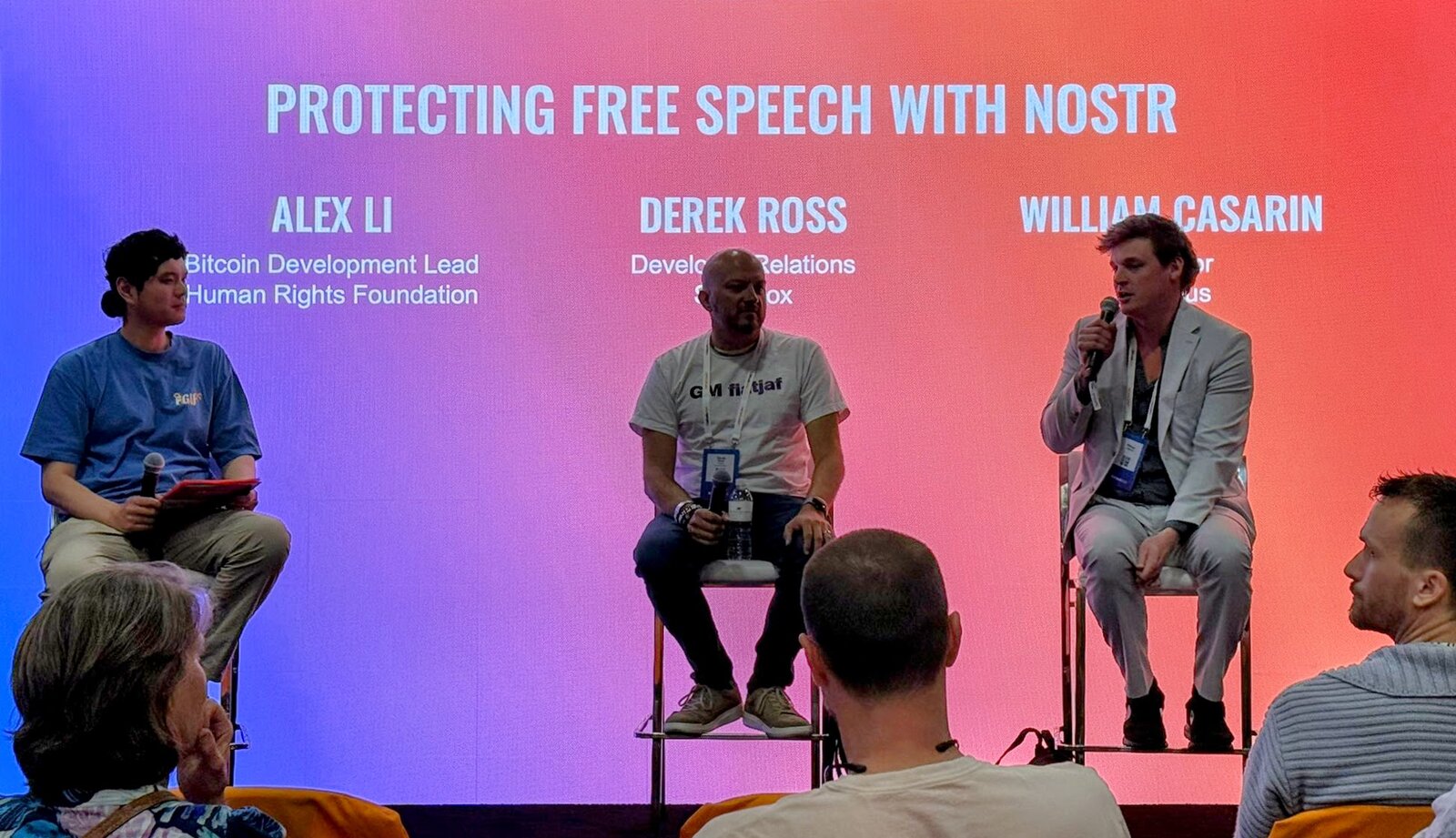
Back on the HRF stage with Alex Li and William Casarin. The focus: why Nostr matters for free speech, why zaps matter for economic freedom, and why the freedom to communicate is the foundation everything else rests on.
The core argument is simple: you can't have free speech on someone else's server. Twitter, Facebook, YouTube — every centralized platform caves to government pressure eventually, and Section 230 doesn't protect you when the platform itself wants to censor. Nostr has no server to seize, no CEO to pressure, and no company to subpoena. Freedom of speech becomes a technical guarantee instead of a legal one.
I pointed to Agora as the working example. Built at HRF's AI Hack for Freedom in January, now in active use by Venezuelan activists, with Bluetooth mesh fallback for internet blackouts and self-custodial Lightning for frozen bank accounts. Ditto as the flagship Nostr client — builds to static files, self-hostable on a Raspberry Pi or any VPS, no email and no phone number required. Shakespeare as the tool that lets anyone build and deploy freedom-first software without needing a dev team. William brought the Damus perspective: an iOS Nostr client that Apple almost didn't approve, which is a reminder that free speech infrastructure still has to fight for distribution even when the protocol itself can't be stopped.
The sharpest point William made — and one I don't think enough developers in the room had thought about — was on Nostr Git. GitHub has had a rough stretch lately: multiple major outages in a single month, plus a long, well-documented history of censoring code. And code is speech. If you build on open protocols for money (Bitcoin), identity and communication (Nostr), but you're still hosting the code itself on a centralized platform that can go down at any moment or delist your repo on a policy whim, you've left a massive single point of failure in your stack. Nostr Git (NIP-34) fixes that. Your repos live on Nostr relays, they're cryptographically signed by you, and no one company can take them offline. William made the case bluntly: if you're serious about freedom tech, the Git layer has to be as decentralized as everything else. Hard to argue with.
The tooling is already here and already usable today:
- NostrHub — Soapbox's Nostr developer platform. Host Nostr Git repos, publish and discover custom NIPs, browse the Nostr app directory, and participate in developer community discussions. It's the "one place" for Nostr builders and it's where a lot of our own work now lives.
- gitworkshop.dev — a web-based Nostr Git frontend that makes browsing, issuing patches, and collaborating on NIP-34 repos feel as natural as using GitHub. A great complement to NostrHub for anyone who wants a familiar web UI on top of Nostr-native git.
- ngit — the CLI tool that makes Nostr Git actually practical.
ngit push,ngit fetch, real workflow parity with the Git you already know. If you've been waiting for "Nostr Git, but usable from my terminal," this is it.
The pitch to every developer in that room: your money is sovereign, your identity is sovereign, your speech is sovereign — it's time your source code is, too.
Short panel, but the room was HRF's audience — the exact people we need to be reaching, and the exact audience where Soapbox's mission lands hardest.
Panel 5: AI + Bitcoin + Nostr = The Freedom Tech Stack (Genesis Stage)
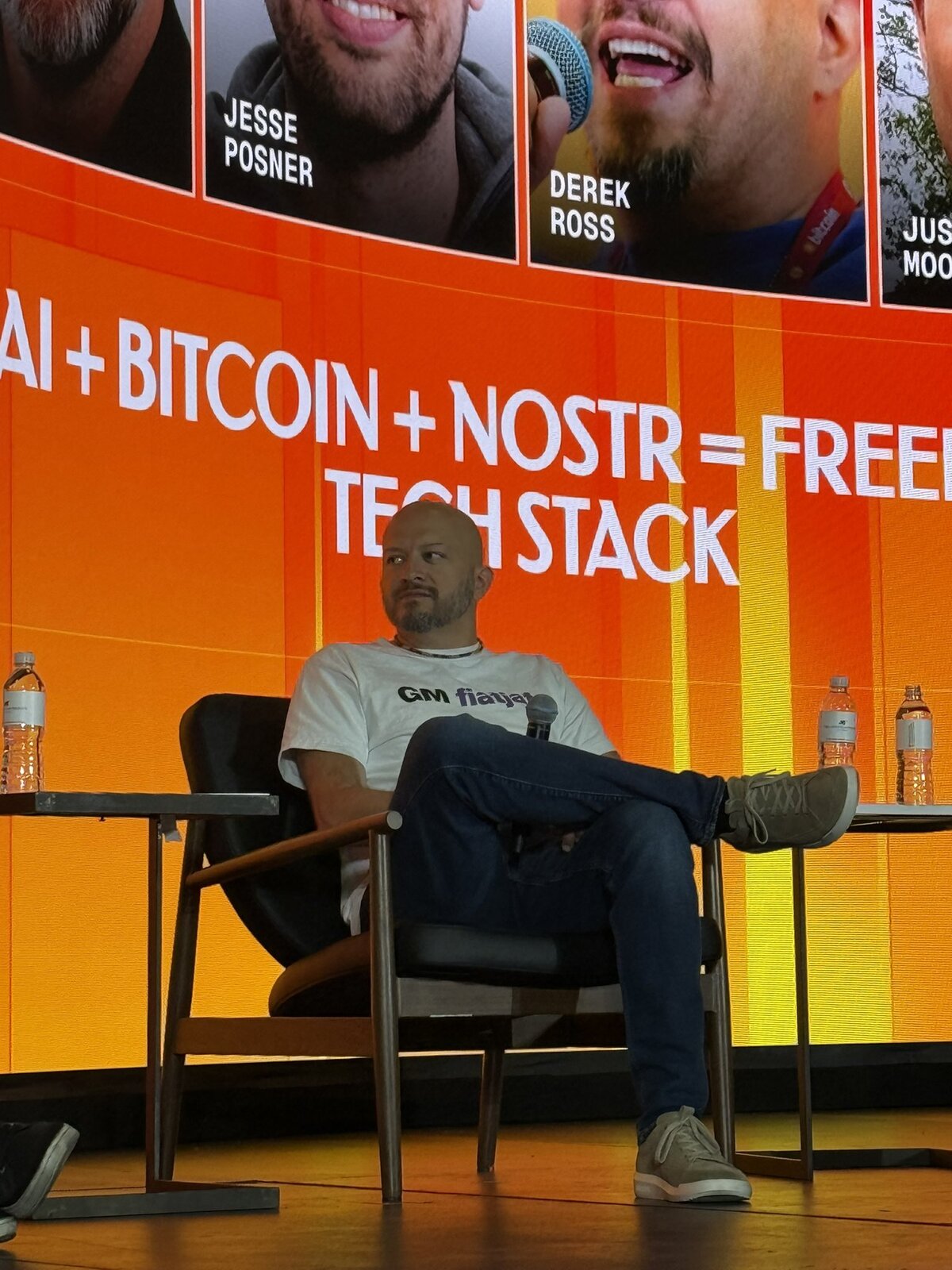
The week closed on the Genesis Stage with Justin Moon moderating, alongside Jesse Posner (Vora) and Mark Suman (Maple AI). Jesse and Mark brought the serious AI privacy angles. Vora is personal AI that's private, powerful, and owned by you — the antithesis of the ChatGPT model where your queries, history, and identity all live on someone else's server. Maple AI is privacy-preserving AI that actually respects user data. Both are essential pieces of the freedom tech stack, and both are exactly the right kind of partners for a conversation about sovereign intelligence.
My contribution walked through how we got here. In the '90s, the internet was decentralized by default — but to scale, we had to hand the infrastructure over to Big Tech. We now, in 2026, finally have the stack to reverse that. Fast internet everywhere. Cheap compute. Easy self-hosting. Point-and-click deploys. AI that assists non-developers in shipping production software. The tools have finally caught up to the vision.
Nostr is the communication and identity layer. Bitcoin is the settlement and value layer. Open AI is the intelligence layer. Stacked together, they form the foundation for a truly sovereign internet. This isn't 2030. This is today.
The Soapbox Stack — Everything We Showed Up With
For readers who want a quick reference of everything we demoed, discussed, and pointed people toward this week:
- Ditto — Our flagship Nostr social client. Your content, your vibe, your rules. Bridges to Bluesky and Mastodon. 27+ content types, full profile theming, self-hostable.
- Shakespeare — AI-powered website and app builder. Describe it, build it, deploy it. Open source and self-hostable.
- Agora — Censorship-resistant activist platform built with HRF and the World Liberty Congress. Bluetooth mesh + self-custodial Lightning + Nostr. In active use in Venezuela; expanding in 2026.
- Mostr — The bridge that connects Nostr, Mastodon, and Bluesky. 56,000+ users connected across networks.
- Soapbox Signer — NIP-07 browser extension for secure Nostr key management.
- Soapbox Sessions — Our weekly Nostr-native podcast on decentralized social, freedom tech, and ecosystem news. New episodes every Thursday.
Why This Week Was Worth It
A week like this isn't cheap. Flights, hotels, sponsorships, swag, private events, and a team on the ground — Bitcoin Conference Week is one of the biggest marketing line items on our annual calendar. I take that seriously, and so does the rest of Soapbox. Every dollar has to work.
And there is no better community in the world to invest that dollar in than the Bitcoin community. Bitcoiners already understand decentralization. They already understand censorship resistance. They already understand the need to control their own keys and opt out of systems that don't serve them. They live freedom tech every day with their money — they don't need to be convinced that Big Tech is broken, or that the alternative has to be permissionless and self-custodial, because that's the entire reason they got into Bitcoin in the first place. Telling a Bitcoiner that their identity, their speech, and their social graph deserve the same sovereignty as their savings isn't a sales pitch; it's a logical extension of beliefs they already hold. That's why Bitcoin Conference Week is the single most fertile ground in the world for onboarding to Nostr — and it's why we keep showing up here in force.
Here's why I believe this week was one of the highest-ROI investments we've made all year:
- Five panels across two days put Soapbox and Nostr in front of every major audience at the conference — developers, activists, investors, press, and the broader Bitcoin community. That kind of stage presence is not something you can buy with ads.
- NosVegas 2.0 was a mainstage moment for Nostr. Live V4V music, a full slate of talks, and a packed nightclub full of people who walked out wanting to build. That's earned attention, not paid attention.
- Agora and Ditto landed with the right audiences. HRF, activists, journalists, and builders are now actively asking how they can get involved. Agora's story — shipped in a weekend, in active use by Venezuelans — is the exact kind of real-world proof that moves both users and funders.
- Shakespeare is becoming the default "how do I build on Nostr?" answer. Every panel conversation eventually came back to it. Every developer I met either uses it or wants to.
- The relationships we compounded this week — with HRF, White Noise / IPF, NosFabrica, Vora, Maple AI, OpenAgents, ZBD, BTCPayServer, and dozens of others — are the real asset. This is community building as a long-term investment: every one of those relationships seeds the next partnership, the next collaboration, the next grant, and the next wave of people getting onboarded to Nostr through someone they already trust. You can't buy that with ad spend. You build it by showing up.
- The purple-pill-orange-pill flywheel is working. Bitcoiners who came for the conference left with Ditto on their phones and sats flowing through them via zaps. Nostr-natives who came for NosVegas walked out with new Bitcoin tools they'd never touched before. Every direction of onboarding was happening at the same time, all week, and that's the best signal you can possibly get that you're investing in the right community.
The bet we made at Soapbox was that freedom tech is ready for its mainstream moment, and that showing up loud and often at the intersection of Bitcoin, Nostr, and AI is how you catalyze it. This week proved that bet. The ecosystem is bigger, more capable, and more ready to ship than it has ever been.
What's Next
If anything here resonated with you — whether you're a developer, an activist, a musician, a journalist, or just someone who's tired of Big Tech running your social life — here's where to start:
- Try Ditto: ditto.pub. No email. No phone number. Just a Nostr key.
- Build with Shakespeare: shakespeare.diy. Describe a site. Deploy it. Own it.
- Support activists with Agora: agora.spot. Real people, real freedom, real impact.
- Subscribe to Soapbox Sessions: sessions.soapbox.pub. Weekly, Nostr-native.
We're not done. We're barely getting started. The next conference will be bigger, the next NosVegas louder, and the next generation of Soapbox products will make the freedom tech stack feel inevitable to anyone who touches it.
Thank you to every partner, sponsor, speaker, musician, and builder who made this week what it was. Thank you to HRF, to the Bitcoin conference organizers, and to everyone who showed up ready to work.
See you at the next one.
Soapbox is funded by grants and donations, not ads or data sales.
Everything we build is open source and belongs to the community. Help us keep it that way.