Coding Doesn't Die. It Evolves.
Elon Musk says coding dies by December. He's right about the direction. He's wrong about the conclusion. The future belongs to people who can think.
Elon Musk thinks coding dies this year.
Not evolves. Dies.
"I think by the end of this year you don't even bother doing coding. The AI will just create the binary directly. And the AI can create a much more efficient binary than can be done by any compiler."
No source code. No compilation. No intermediate steps. AI handles the entire pipeline from intention to execution. The profession, in his framing, simply ceases to exist.
The internet ran with it. One X post rewrote his comments into something even more dramatic: "The entire profession collapses into a thought. Decades of training reduced to irrelevance." Thousands of retweets. Panic in the replies.
Here's the thing. Musk isn't wrong about the direction. He's wrong about the conclusion.
We Saw This Coming
Earlier this month, we published "Vibe Coding at One: From Meme to Movement" — the story of how AI-assisted development went from Andrej Karpathy's throwaway tweet to Collins Dictionary Word of the Year in twelve months.
The trajectory is undeniable. GPT-4.5 scored 38% on SWE-bench when Karpathy coined "vibe coding." Claude Opus 4.5 now exceeds 80%. Y Combinator's Winter 2025 batch shipped products with 95% AI-generated code. Linus Torvalds started vibe coding Python visualizers.
We didn't just watch this happen. We built for it. MKStack. Shakespeare. Quilly. An entire stack designed for the world Musk is describing — where humans stop writing code and start directing it.
So when Musk says coding dies? We've been operating on that assumption for over a year.
But we reached a different conclusion.
Coding Doesn't Die. It Sheds Its Skin.
Every major technology shift follows the same pattern. The old skill doesn't vanish. It transforms.
Photography didn't kill painting. It freed painters from realism and gave us impressionism, abstract expressionism, the entire modern art movement. The camera handled representation. The human handled meaning.
Calculators didn't kill mathematics. They killed arithmetic as a career skill and elevated mathematical thinking. Nobody mourns the room full of human computers at NASA. We celebrate the engineers who told them what to calculate.
AI doesn't kill coding. It kills code-as-manual-labor and elevates code-as-creative-direction.
Musk sees the elimination of the intermediate step — source code, compilers, the whole translation layer between human intent and machine execution. Fine. That layer was always friction. We called it "a tax we paid because machines didn't speak human."
But removing the tax doesn't remove the taxpayer. Someone still has to know what to build, why to build it, and whether what got built is actually right.
That someone just stopped being called a "coder."
The Producer, Not the Instrumentalist
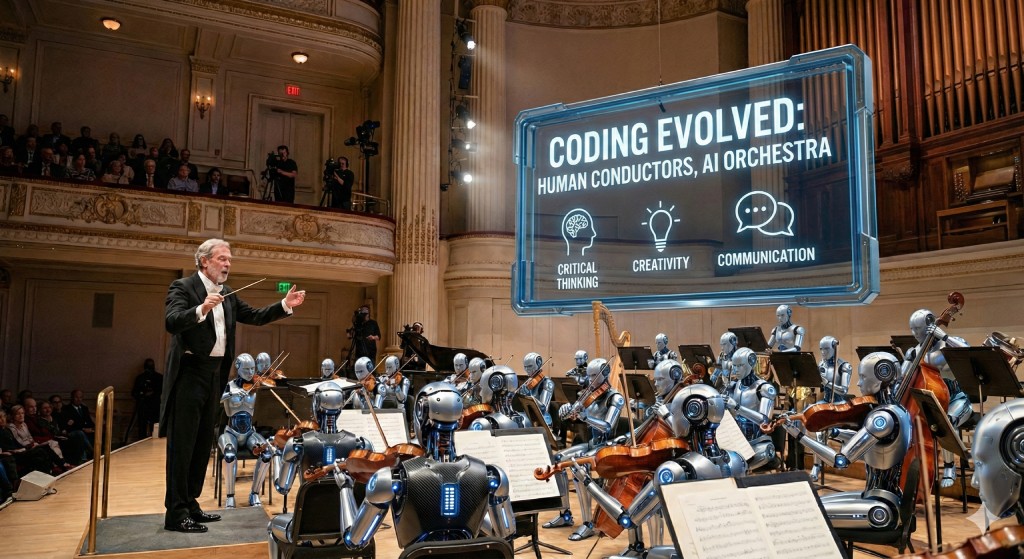
In our anniversary post, we introduced the producer mindset: the idea that vibe coding inverts the developer role the same way music production inverted the musician role.
The producer doesn't play every instrument. The producer's job is taste, direction, knowing when it's done. They shape the song without writing every note.
Musk's prediction accelerates this. If AI generates binary directly from intent, the producer role doesn't disappear — it becomes the only role. Vision. Judgment. Knowing when the output matches the intention and when it's subtly, dangerously wrong.
"I'm frankly exhausted by the end of the day... it's a deeply intellectual exercise."
He meant it as criticism. It's actually the job description for the next era.
The 3 C's of the Post-Code World
So what skills survive when the syntax disappears?
Not technical ones. Human ones.
The 3 C's of the Post-Code World
Creativity
AI can generate. It can't originate. It remixes what exists. It doesn't see what's missing. Your ability to imagine what doesn't exist yet — that's not automatable. That's the spark. AI is an incredible amplifier. But amplifiers need a signal.
Critical Thinking
AI will give you confident answers. Beautifully formatted, syntactically perfect, completely wrong answers. The Lovable security scandal proved this — 170 apps shipped with exposed user data because vibes met production without judgment.
Communication
This is the sleeper skill. The people who can clearly articulate what they want — to humans and to machines — will run circles around everyone else. In Musk's world of imagination-to-software, the quality of the imagination isn't what matters most. It's the quality of the articulation.
Not a single one of them requires writing a for-loop.
The Spaghetti Still Needs a Chef
Here's what the "coding is dead" crowd consistently misses.
When AI generates code today — even the best models — the output is what we call digital spaghetti. It works. Usually. Until it doesn't. And when it doesn't, someone needs to understand why.
The skeptics have a point. One veteran programmer noted that projects generated exclusively by AI "invariably result in spaghetti code that is next to impossible to maintain and extend." Companies that went all-in on AI coding are reporting more tech debt in six months than legacy systems accumulated in a decade.
But here's where we diverge from the skeptics too.
We don't think the answer is to reject AI and cling to manual coding. We think the answer is better infrastructure. On Nostr, your data lives on relays, not in your app. The app is just a view layer. If your AI-generated frontend becomes unmaintainable, rebuild it from scratch — your data survives. Throw the spaghetti at the wall. See what sticks. Rebuild what doesn't.
The protocol is the architecture. The app is just vibes. That was true a year ago. It's even more true in Musk's imagined future.
The Real Prediction
Musk says coding dies by December.
Here's what actually happens by December: coding becomes invisible. The same way electricity became invisible. You don't think about the power grid when you flip a light switch. You won't think about code when you ship a product.
But someone designed that power grid. Someone maintains it. Someone notices when the voltage fluctuates before the lights go out.
The future doesn't belong to people who can code.
It belongs to people who can think.
The 3 C's aren't a consolation prize for displaced developers. They're the new core curriculum for anyone who wants to build anything — with AI, through AI, beyond AI.
Musk is right that the gap between idea and execution is collapsing toward zero. He's wrong that this makes humans irrelevant. It makes the right humans more powerful than ever.
We've spent the past year building tools for exactly this future. Not because coding is dying. Because it's evolving. And the people who evolve with it will build things we can't yet imagine.
Keep thinking.
Keep thinking. Keep building.
This is a follow-up to "Vibe Coding at One: From Meme to Movement," published February 2, 2026.
Try Shakespeare and start building the future.
Soapbox is funded by grants and donations, not ads or data sales.
Everything we build is open source and belongs to the community. Help us keep it that way.